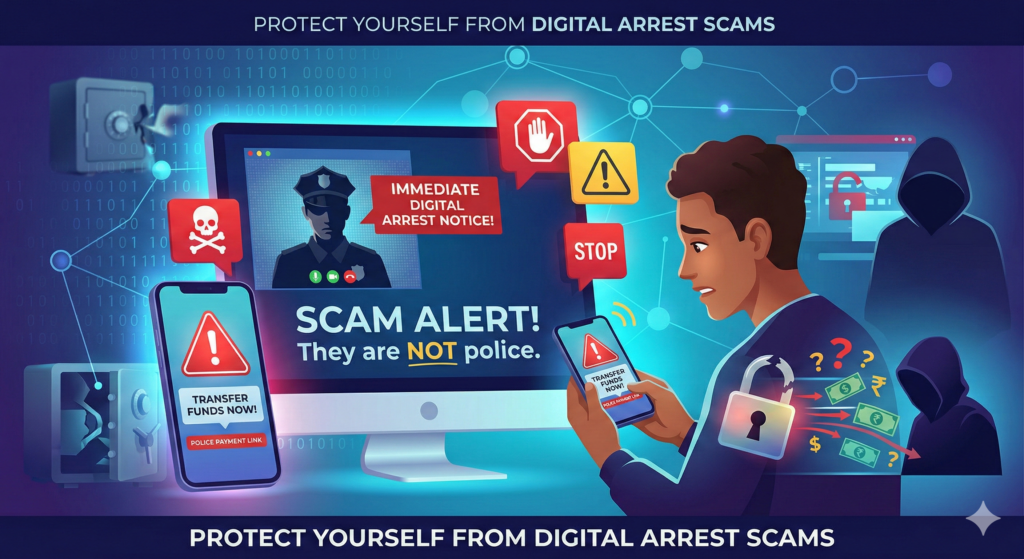
Understanding the Menace and Protecting Yourself
Introduction
In recent years, India has witnessed an alarming surge in a new breed of cybercrime known as “digital arrest” scams. These sophisticated frauds involve criminals impersonating law enforcement officers, judges, and government officials through phone calls and video calls, coercing unsuspecting citizens into transferring large sums of money under the threat of immediate arrest. The scale of this menace is staggering. According to official parliamentary data, Indians lost approximately ₹1,935 crore to digital arrest scams in 2024 alone, with around 1.23 lakh complaints registered on the National Cyber Crime Reporting Portal. The number of reported cases has nearly tripled between 2022 and 2024, making this the fastest-growing cybercrime category in the country.
What makes these scams particularly dangerous is their ability to trap victims from all walks of life — from elderly retirees and senior citizens to educated professionals, doctors, engineers, businessmen, and even former police officers. No one is immune. Prime Minister Narendra Modi himself addressed this menace in his Mann Ki Baat broadcast on 27th October 2024, categorically stating: “There is no system like digital arrest under the law. This is just fraud, deceit, and lies.”
This article aims to educate the public about the mechanics of digital arrest scams, the legal position, warning signs, and most importantly, actionable steps every citizen can take to protect themselves and their families from falling prey to these criminal networks.
What is a “Digital Arrest”?
A digital arrest is a completely fabricated concept used by cybercriminals to deceive and extort money from innocent people. There is no legal provision under Indian law — neither under the Bharatiya Nyaya Sanhita (BNS) 2023, the Code of Criminal Procedure, nor the Information Technology Act — that authorises any form of “digital arrest.” As confirmed by law enforcement authorities across the country, no police officer, CBI official, judge, or any government authority has the power to arrest anyone over a phone call or video call.
In this scam, fraudsters impersonate officials from agencies such as the Central Bureau of Investigation (CBI), Enforcement Directorate (ED), Reserve Bank of India (RBI), Narcotics Control Bureau (NCB), Customs Department, Telecom Regulatory Authority of India (TRAI), or even the Supreme Court of India. They use sophisticated tactics including fake uniforms, fabricated identity cards, forged FIR copies, doctored arrest warrants, and even simulated courtroom setups during video calls to create a terrifyingly convincing scenario.
How the Scam Works: The Modus Operandi
Understanding the step-by-step methodology used by these criminals is the first line of defence. Digital arrest scams typically follow a well-rehearsed pattern:
Stage 1: Initial Contact
The scam begins with an unsolicited phone call, often through WhatsApp or Skype, or sometimes a regular telephone call. The caller may claim to be from a courier company (such as FedEx or India Post) and inform the victim that a parcel in their name containing drugs, fake passports, or illegal documents has been intercepted. Alternatively, the call may come from someone claiming to be from a telecom provider, stating that the victim’s SIM card or phone number has been used for illegal activities. In some cases, the caller uses international spoofed numbers that appear to be legitimate Indian numbers.
Stage 2: Escalation and Intimidation
Once the victim engages, the call is quickly “transferred” to someone impersonating a senior police officer, CBI official, or ED officer. This person levels serious accusations — money laundering, drug trafficking, terrorism financing, or tax evasion. The victim is told that an FIR has been registered against them and that an arrest warrant has been issued. Fake documents, including fabricated FIR copies and official-looking letters bearing government logos, are shared via WhatsApp to add credibility.
Stage 3: Digital Confinement
This is the most psychologically damaging phase. The victim is instructed to switch on their camera and remain on a continuous video call — sometimes for hours or even days. They are strictly warned not to contact anyone, not to speak to family members, and not to disconnect the call under any circumstances. The scammers maintain constant surveillance, creating an environment of extreme fear, isolation, and psychological control. Some victims have been kept under such “digital arrest” for over 40 hours continuously.
Stage 4: Financial Extortion
The scammers then offer the victim a way out — by paying a “security deposit,” “bail amount,” “verification fee,” or “fine” to have the case dropped or to “clear their name.” Payments are demanded through bank transfers, UPI transactions, or cryptocurrency transfers to specific accounts. Multiple transactions are often demanded over several hours or days, draining the victim’s savings completely. In the most egregious cases, victims have been forced to take loans or liquidate fixed deposits.
Stage 5: Disappearance
Once the money has been transferred, the scammers vanish without a trace. The phone numbers become unreachable, the video call links stop working, and the victim is left devastated — both financially and emotionally. Many victims suffer from severe anxiety, depression, and post-traumatic stress. In the most tragic cases, some victims have taken their own lives, unable to cope with the financial and emotional trauma.
Notable Cases That Shook the Nation
The reach and audacity of digital arrest scams is evident from several high-profile cases that have been reported across India:
- S.P. Oswal, Chairman of Vardhman Group: The 82-year-old textile magnate was held under “digital arrest” for two days in August 2024, during which he was defrauded of ₹7 crore. The scammers set up a fake virtual courtroom, complete with an impersonator posing as the Chief Justice of India.
- Dr. Ruchika Tandon, Neurologist at SGPIMS, Lucknow: An Associate Professor at a premier medical institute was duped of ₹2.81 crore after scammers posed as TRAI and CBI officials, accusing her of being involved in money laundering.
- Kolkata Businessman: A 41-year-old businessman lost ₹75.5 lakh during a 12-day digital arrest in February 2025, with scammers maintaining constant surveillance and mental pressure.
- Retired Engineer, Delhi: A 70-year-old retired engineer lost all his life savings to digital arrest scammers in November 2024.
These cases illustrate that digital arrest scams do not discriminate — they target people of all ages, professions, and socio-economic backgrounds, exploiting the universal human vulnerability to authority and fear.
The Legal Position: What Indian Law Says
It is critical for every citizen to understand the legal position clearly:
- No provision of “digital arrest” exists under any Indian law. Neither the Bharatiya Nyaya Sanhita, 2023, nor the Bharatiya Nagarik Suraksha Sanhita, 2023, nor the Information Technology Act, 2000, authorises any form of arrest conducted through phone or video calls.
- Arrest procedures under Indian law are strictly codified. An arrest must be made physically, in the presence of the individual, with proper warrant or under specific circumstances permitted by law. No investigating officer can demand money to “settle” or “close” a case.
- Courts do not conduct proceedings over video calls or WhatsApp. While virtual hearings do occur through designated official platforms, no court will ever conduct proceedings via WhatsApp, Skype, or similar applications, and certainly not on the basis of an unsolicited call.
- Government agencies never demand money over phone calls. No legitimate investigating agency — be it the CBI, ED, Police, or any other body — will ever demand money transfers as a condition for avoiding arrest or dropping charges.
- The Supreme Court has taken cognisance. In late 2025, the Supreme Court of India directed a pan-India probe into digital arrest scams, instructing the CBI to coordinate investigations and work with banks and telecom providers to trace and freeze accounts linked to these criminal networks.
Digital arrest frauds are punishable under multiple provisions, including Sections 318, 319, and 336 of the Bharatiya Nyaya Sanhita, 2023 (relating to cheating, fraud, and impersonation), as well as Sections 66C and 66D of the Information Technology Act, 2000 (identity theft and cheating by personation using computer resources).
Red Flags: How to Identify a Digital Arrest Scam
Awareness of warning signs is the most powerful shield against these scams. Be immediately alert if you encounter any of the following:
- Unsolicited calls from unknown numbers claiming to be from police, CBI, ED, RBI, customs, TRAI, or courier companies.
- Immediate accusations of serious crimes such as money laundering, drug trafficking, or terrorism financing — without any prior notice or formal summons.
- Demands to join a video call via WhatsApp, Skype, or similar platforms and to keep your camera turned on continuously.
- Instructions to maintain secrecy and not speak to family members, friends, or lawyers about the situation.
- Sharing of official-looking documents such as FIR copies, arrest warrants, or court orders through WhatsApp or email.
- Demands for money transfers to “settle” the case, pay a “fine,” or deposit a “security amount” into specific bank accounts.
- Requests for personal information including Aadhaar number, PAN card details, bank account information, OTPs, or UPI PINs.
- Creating a sense of extreme urgency by threatening that police are already on their way to your house if you don’t comply immediately.
How to Protect Yourself: A Citizen’s Action Guide
Following the Hon’ble Prime Minister’s advisory to “Stop, Think, and Act,” here are comprehensive steps every citizen should follow:
1. Stop — Do Not Panic
The entire success of a digital arrest scam depends on inducing panic. The moment you feel fear or urgency from any call claiming to be from a government agency, stop and take a deep breath. Remember: no real government officer will ever threaten you with arrest over a phone call. Fear is the scammer’s primary weapon — do not hand them this power.
2. Think — Verify Independently
Do not rely on any phone number or contact information provided by the caller. Instead, independently search for the official phone number of the agency in question and call them directly to verify the claims. Contact your local police station. If someone claims to be a judge or court official, remember that no court conducts proceedings through WhatsApp or Skype calls.
3. Act — Disconnect and Report
Disconnect the call immediately. Do not engage further. Report the incident through the following official channels:
| Channel | Details |
| Cyber Crime Helpline | Dial 1930 (24×7 helpline) |
| National Cyber Crime Portal | www.cybercrime.gov.in |
| Local Police Station | File an FIR with all evidence |
| Chakshu Portal (DoT) | sancharsaathi.gov.in — Report fraudulent calls/SMS |
| CyberDost (I4C Social Media) | @CyberDost on X (Twitter), Facebook, Instagram |
| Your Bank’s Helpline | Report compromised accounts immediately |
4. Never Share Sensitive Information
Under no circumstances should you share your bank account details, OTPs, UPI PINs, Aadhaar number, PAN card details, or passwords with any unknown caller. No legitimate government agency will ever ask for such information over a phone call.
5. Never Transfer Money
Legitimate investigations do not require payment of money as a condition for avoiding arrest. If anyone demands money transfer to “settle” a case or pay a “fine,” it is a scam — without exception.
6. Talk to Someone You Trust
One of the most effective tactics scammers use is isolation. They will insist that you must not tell anyone about the call. This is a major red flag. Always share the information with a trusted family member, friend, or your lawyer before taking any action. Scams thrive in secrecy and collapse in daylight.
7. Install Caller ID and Spam Detection Apps
Use applications like Truecaller or similar caller identification services that can flag known scam numbers. While not foolproof, these tools add an additional layer of protection.
8. Educate Vulnerable Family Members
Elderly parents, grandparents, and less tech-savvy family members are particularly vulnerable. Have an open and detailed conversation with them about how these scams work. Explain that the government never calls people to arrest them digitally. Create a family protocol where no financial decision is made without consulting at least one other family member.
What To Do If You Have Already Been Scammed
If you have already fallen victim to a digital arrest scam, time is of the essence. Take the following steps immediately:
- Call the Cyber Crime Helpline 1930 immediately. If you report within 15–20 minutes of making a fraudulent transfer, there is a chance the transaction can be frozen and your money recovered.
- File an online complaint at the National Cyber Crime Reporting Portal: www.cybercrime.gov.in
- File an FIR at your nearest police station with all available evidence — call recordings, screenshots, transaction details, and any documents shared by the scammers.
- Contact your bank immediately to freeze further transactions, block compromised accounts, and change all passwords.
- Preserve all evidence — do not delete any messages, call logs, or screenshots. These will be crucial for investigation and prosecution.
- Report suspicious calls on the Chakshu Portal: sancharsaathi.gov.in — This is a Government of India initiative under the Department of Telecom for reporting fraudulent communications.
Government Initiatives to Combat Digital Arrest Scams
The Central Government and various law enforcement agencies have taken several measures to address this growing threat:
- Indian Cyber Crime Coordination Centre (I4C): Under the Ministry of Home Affairs, I4C coordinates all efforts to combat cybercrime nationally, including digital arrest scams.
- Blocking of Spoofed Calls: The government, in collaboration with Telecom Service Providers, has developed systems to identify and block international spoofed calls that appear to originate from Indian numbers.
- Massive Blocking Operations: Over 6.69 lakh SIM cards, 1,32,000 IMEIs, 83,668 WhatsApp accounts, and 3,962 Skype IDs linked to digital arrest scams have been blocked.
- Supreme Court Intervention: The Supreme Court has directed a pan-India probe, asking the CBI to coordinate investigations across states and work with banks and telecom providers.
- CERT-In Advisories: The Indian Computer Emergency Response Team has issued guidelines and advisories to help citizens protect themselves.
- Samanvaya Platform: A joint management information system providing insights on interstate linkages of cybercrimes, aiding detection and investigation.
- International Cooperation: FBI-CBI cooperation has intensified, with joint operations resulting in hundreds of arrests across borders.
Conclusion: Awareness is Our Greatest Weapon
Digital arrest scams represent a clear and present danger to every Indian citizen in our increasingly connected digital world. These criminal networks exploit our innate trust in authority, our fear of legal consequences, and our isolation in moments of panic to rob us of our hard-earned savings and our peace of mind.
However, awareness is the most powerful antidote to this menace. When citizens are informed, alert, and empowered with the knowledge that no such thing as a “digital arrest” exists under Indian law, these scams lose their power. Every conversation we have with our family, friends, and colleagues about these scams is a step towards building a more resilient society.
As legal professionals, it is our duty to spread awareness about citizens’ rights. As citizens, it is our collective responsibility to protect the vulnerable among us. Let us break the culture of shame and silence around cybercrime victimisation, and instead foster an environment where victims feel empowered to report these crimes without fear of stigma.
| REMEMBER “Digital Arrest” does not exist under any Indian law. No police officer, judge, or government official will ever arrest you over a phone or video call. No government agency will ever demand money over a call to avoid arrest. STOP • THINK • ACT |
Disclaimer: This article is for informational and awareness purposes only and does not constitute legal advice. For specific legal queries, please consult a qualified legal professional.